Why Industrial Networks Need Industrial Switches
Something we’ve seen quite a few times over the years is office-grade switches ending up in industrial environments.
On paper it makes sense. They're cheaper, they're available, and they seem to do exactly the same thing.
Until they don't...
Why Industrial Networks Need Industrial Switches
When network problems occur in industrial environments, the switch is not always the first thing people look at.
Attention often turns to PLCs, drives, software or field devices. However, the network infrastructure itself can be the root cause of many intermittent and difficult to diagnose issues.
One common example is the use of standard office-grade Ethernet switches within machine control panels and production environments.
At first glance, this seems perfectly reasonable. The job of an Ethernet switch is to move data from one device to another, and office switches are often readily available and cost-effective.
The challenge is that industrial environments place very different demands on networking equipment.
Not Designed for the Factory Floor
Office switches are designed for relatively clean, temperature-controlled environments. Industrial installations are often very different.
Depending on the application, a switch may be exposed to:
- Electrical noise from motors, drives and other high-power equipment
- Constant vibration from machinery
- Dust and airborne contaminants
- Continuous 24/7 operation
While an office switch may function perfectly well in these conditions initially, reliability can begin to suffer over time.
The Real Problem: Intermittent Faults
Complete switch failure can, and does happen, but it's often not the biggest issue. Changing out a failed switch is fairly straightforward.
The bigger problem is when the switch doesn't completely fail, but starts behaving inconsistently or, to use the technical term, starts acting "weird".
You might see devices randomly dropping off the network, ports repeatedly disconnecting and reconnecting (something network engineers often refer to as "port flapping), unstable communications, or faults that seem to disappear as quickly as they started.
These are often the most time-consuming issues to investigate because there is no clear point of failure, just a collection of symptoms that don't always show themselves when you're looking for them.
Why Industrial Switches Are Different
Industrial Ethernet switches are specifically designed to operate in harsher conditions.
Features such as wider operating temperature ranges, improved resistance to electrical interference, ruggedised construction and support for continuous operation help maintain reliable communications where standard office equipment may struggle.
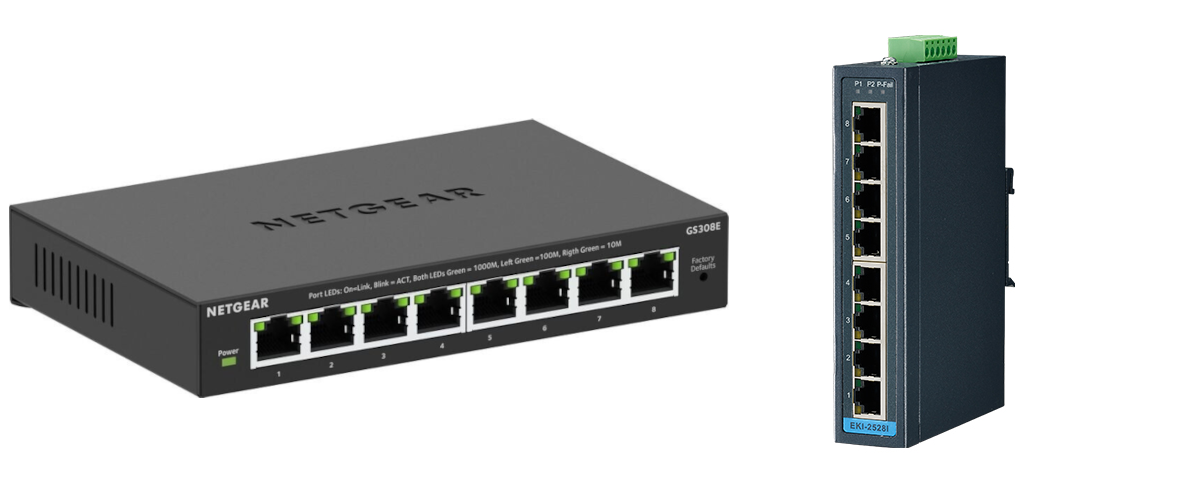
For example, the switches below look very similar. They both come with eight Ethernet ports, both are housed in metal enclosures, and both do a great job of passing data from one port to another.
However, one is designed for an office environment and the Advantech switch is designed for an industrial environment.
The switch on the left is a perfectly capable unmanaged office-grade switch with an operating temperature range of 0°C to 40°C. That's perfectly acceptable in an office. The switch on the right, however, is an industrial networking switch made by Advantech - a manufacturer with decades of experience designing technology specifically for demanding industrial environments, and has an operating temperature range of -40°C to 75°C.
Looking at the temperature ratings alone, it's fairly easy to see that these switches are intended for very different environments. When you start thinking about machinery, control panels, outdoor installations and other industrial applications, it becomes clear why choosing the correct hardware matters.
And temperature is only one part of the story. Industrial switches are typically designed to cope with vibration, electrical interference, wider input voltage ranges and continuous operation in a way that office equipment generally isn't. While an office switch may work perfectly well in an industrial environment for a period of time, the question is whether it will continue to do so reliably when conditions are less than ideal.
For critical industrial applications, these design differences can make a significant impact on long-term reliability.
Reliability Matters
Modern production systems rely heavily on stable network communications. When devices, controllers and machines are connected through Ethernet networks, the switch becomes a critical part of the infrastructure.
The cost of an industrial switch is often small compared to the cost of diagnosing intermittent faults or dealing with unplanned downtime.
For that reason, it is worth considering whether the network hardware is designed for the environment it's operating in.
In many cases, the question is not whether an office switch will work, but how reliably it will continue to work when exposed to the realities of an industrial environment.
If you're specifying network infrastructure for an industrial application and aren't sure whether a standard or industrial switch is the right fit, we're always happy to help. We supply a range of industrial Ethernet switches and can advise on the most suitable solution for your application. You can visit our Advantech industrial switch range or Contact us to learn more.